


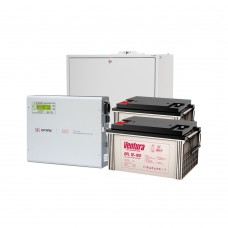

The online UPS SW500L with 120 Ah batteries installed in the battery rack BS-24-1W is designed for autonomous operation for 5 h (at 80% load) of connected consumers with a power of up to 500 VA /400 W. The solution is well suited for a gas boiler and circulation pump, water purification system, CCTV cameras, audio and video equipment, as well as a low-power computer.
Battery runtime at other UPS load levels is shown on the Battery operation tab.
The power supply is also capable of protecting the load from voltage fluctuations and electrical interference. It features an improved power factor corrector algorithm, which enables it to operate efficiently with a generator.
The SW500L UPS with 120 Ah batteries is based on double-conversion technology, which achieves:
- voltage correction with high accuracy (±2%) over a wide range (90-295 V) without switching to battery mode;
- instant and seamless transition of the load power to the battery when the power fails or the voltage goes outside the above range;
- supplying consumers with voltage having a perfect sinusoidal waveform.
The UPS is equipped with a silent convection (fanless) cooling system.
Installation and connection
The UPS is mounted on a flat vertical surface using a bracket. The battery rack is placed on the floor.
Batteries are installed in the rack strictly in accordance with the operating instructions. It is important that the rack circuit breaker is in the OFF position and its cable is disconnected from the UPS.
The UPS is connected to the mains via a cord with a Schuko plug. The rack with the installed battery is connected to the already switched-on power supply via a TD50A-TD50A cable. The load is connected to the UPS last.
The scope of supply includes all components required for installation and connection of the devices.
Battery charging
The batteries in the battery rack are charged by the charger built into the UPS with a current of 5 A.
The UPS has modern technologies for reducing charging time and extending battery life (intelligent charging and battery charge temperature compensation), algorithms for disconnecting the battery at 80-85% discharge (protection against deep discharge), user notifications about battery wear and prediction of runtime at the current load.
Protection
The SW500L has electronic protection against short circuit, prolonged output overload and internal overheating.
Once the cause of the protection activation is eliminated, automatic recovery of UPS operation is ensured.
The built-in varistor (2 kV (case-to-wire), 1 kV (wire-to-wire), response time – 50 µs) provides surge protection.
High-frequency filters protect the mains from interference in the 150 kHz - 30 MHz range and the load (from phase-to-neutral interference up to 2.5 kHz).
Built-in emergency protection against UPS faults, when they occur, allows the load to be disconnected or transferred seamlessly via bypass to the mains.
Control panel
Configuration and monitoring of the operating parameters of the power supply are carried out on the control panel with an LCD display, which includes four control buttons and five LED indicators:
- "Status" – device operating mode and occurrence of alarms;
- "Mains" – input mains status;
- "Bypass" – electronic bypass/ECO mode;
- "Inverter" – operation from the inverter;
- "Battery" – battery status.
Types of information on the LCD display:
- input and output voltage values;
- UPS load percentage;
- battery voltage values and their status;
- active and apparent load power;
- alarms with indication of their causes.
The UPS control panel is also used to configure various device operating parameters and to start three types of battery test:
- for 10 seconds (the UPS powers the load from the battery for 10 seconds);
- for a specified time (the UPS powers the load from the battery for a specified time);
- to full discharge (the UPS powers the load from the battery until it is fully discharged, measuring the battery capacity and calibrating it).
Tests can be started and configured via the System menu, UPS Command item.
Monitoring tools
The UPS offers extensive capabilities for organising local/remote monitoring of its operation. For this, an expansion card is connected to the device. Depending on the model, it has the following interfaces:
- RS-232;
- USB or mini-USB;
- "dry" contacts;
- Ethernet (protocols: Web/SNMP/NTP/Modbus TCP/SHTYL).
The operation of the UPS with an installed card can be monitored directly in a web browser or in the Shtyl Device Manager software. The card is not included in the standard scope of supply and is purchased separately.
This equipment is characterised by an excellent price/quality ratio compared with similar products from foreign vendors on the Russian power supply systems market.
- Advantages