


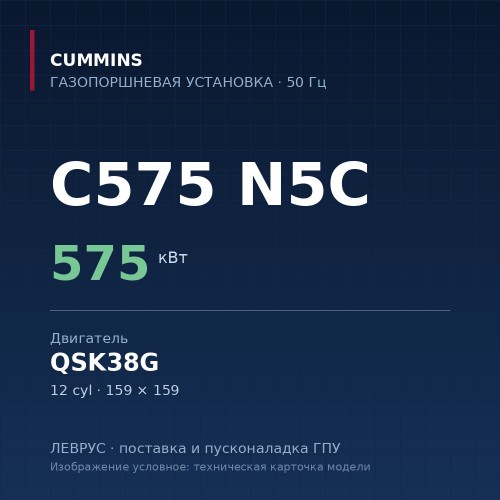

Cummins C575 N5C is a gas generator set built on the QSK38G engine, 50 Hz, 1,500 rpm. Electrical output 575 kW (719 kVA at 0.8 power factor).
Engine: 12 cylinders, V-type, 159 × 159 mm bore and stroke, 37.8 litres displacement, 12.8 bar BMEP, compression ratio 12:1. Electrical efficiency 35.96%, overall efficiency 37.65%. Fuel consumption at full load is 172 m³/h at 0,35–6.0 bar gas supply pressure; minimum methane number without derating is 75.
Heat balance: 339 kW to the high-temperature circuit, 117 kW to the low-temperature circuit and 383 kW in the exhaust at 105 °C, about 839 kW of recoverable heat in total. Exhaust temperature 455 °C, exhaust flow 1.03 kg/s. These figures are what a CHP design is built on.
Dimensions 3 900 × 2 100 × 2 250 mm, wet weight 9,700 kg, oil capacity 145 litres, oil consumption < 0.15 g/kWh. Control panel: PCCP. Time between overhauls 24,000 hours, major overhaul interval 48,000 hours.
Data from the Cummins technical table for C-series 50 Hz sets at 1,500 rpm. Price and lead time on request: the scope depends on the power export scheme, heat recovery arrangement and protection requirements.
Dimensions 3 900×2 100×2 250 mm, mass 9 700 kg. In height and width the set fits a standard 20-ft container, so transport and siting need no abnormal-load permits and installation reduces to foundation work and connections.
Dimensions and weight are taken from the Cummins data sheet for 575GQHA (12/08) for a set with standard features; other configurations (radiator, silencer, container) differ.
Gas requirement: methane number not below 75 without derating, inlet pressure 0,35–6.0 bar, and calorific value within the design range. Where methane number is lower, the set loses output and the duty has to be agreed with the factory rather than adjusted on site: on low-methane gas knock limits load before it shows up in fuel consumption.
Builds and what they change
Each C-series model is built in several variants. The difference is not the rating but the acceptable gas composition, the NOx level and the high-temperature circuit temperature. The build decides whether the set delivers full output on your gas and which heat grade you can recover.
| Build | Fuel | Min. methane number | NOx, mg/Nm³ | HT/LT, °C | Note |
|---|---|---|---|---|---|
| D-0575 | natural gas | 75 | 500 | 85/48 |
Methane number is the gas knock resistance rated under the AVL method. The lower it is, the earlier load has to be limited, which is why natural-gas and low-calorific-gas builds differ in compression ratio rather than only in controller settings.
NOx comes in three levels: 250, 350 and 500 mg/Nm³, set by the emission permit for the site. For the same gas the 350 mg/Nm³ build usually asks for a different methane number than the 500 mg/Nm³ build, as the table shows.
HT/LT are the jacket-water temperatures in the high- and low-temperature circuits. A 110/50 °C circuit supplies heat usable by a wider set of consumers than 95/50 °C, but needs different heat-exchange equipment; the choice follows the heat scheme, not spare margin.
The build is agreed per project: gas, emission limits, heat recovery scheme. Price and lead time depend on the code, so a request is best started from the gas analysis and the emission permit rather than from the kW figure.
How to read the designation, how builds differ by methane number and NOx, and how to size heat recovery — see Cummins C-series 50 Hz: choosing the build.