


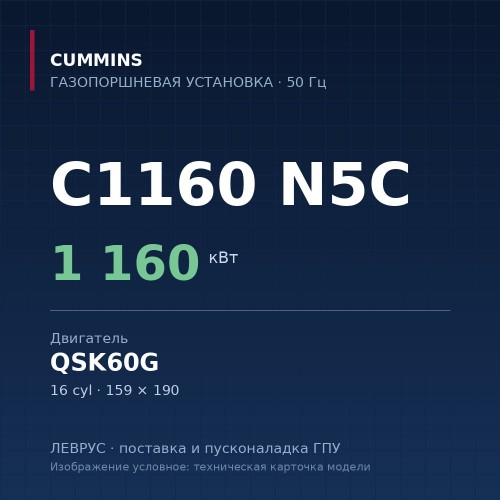

Cummins C1160 N5C is a gas generator set built on the QSK60G engine, 50 Hz, 1,500 rpm. Electrical output 1,160 kW (1,450 kVA at 0.8 power factor).
Engine: 16 cylinders, V-type, 159 × 190 mm bore and stroke, 60.2 litres displacement, 16.1 bar BMEP, compression ratio 11,4:1 / 12:1. Electrical efficiency 39.5%, overall efficiency 40.7%. Fuel consumption at full load is 316 m³/h at 0,25–6.0 bar gas supply pressure; minimum methane number without derating is 61.
Heat balance: 688 kW to the high-temperature circuit, 111 kW to the low-temperature circuit and 755 kW in the exhaust at 105 °C, about 1,554 kW of recoverable heat in total. Exhaust temperature 469 °C, exhaust flow 1.94 kg/s. These figures are what a CHP design is built on.
Dimensions 5,756 × 2,130 × 2,480 mm, wet weight 12,877 kg, oil capacity 380 litres, oil consumption < 0.15 g/kWh. Control panel: PowerCommand 3.3. Time between overhauls 30,000 hours, major overhaul interval 60,000 hours.
Data from the Cummins technical table for C-series 50 Hz sets at 1,500 rpm. Price and lead time on request: the scope depends on the power export scheme, heat recovery arrangement and protection requirements.
The overall height of 2.48 m exceeds the internal height of a standard container, so the set travels on an open platform or in a purpose-built module; for indoor installation the same figure sets the door and hall height requirements.
Gas requirement: methane number not below 61 without derating, inlet pressure 0,25–6.0 bar, and calorific value within the design range. Where methane number is lower, the set loses output and the duty has to be agreed with the factory rather than adjusted on site: on low-methane gas knock limits load before it shows up in fuel consumption.
Builds and what they change
Each C-series model is built in several variants. The difference is not the rating but the acceptable gas composition, the NOx level and the high-temperature circuit temperature. The build decides whether the set delivers full output on your gas and which heat grade you can recover.
| Build | Fuel | Min. methane number | NOx, mg/Nm³ | HT/LT, °C | Note |
|---|---|---|---|---|---|
| D-3239 | natural gas | 69 | 500 | 90/50 | |
| D-3240 | natural gas | 78 | 500 | 95/50 | |
| D-3241 | natural gas | 67 | 350 | 95/40 | |
| D-3242 | natural gas | 73 | 500 | 95/50 | |
| D-3243 | natural gas | 61 | 500 | 90/40 | |
| D-3244 | natural gas | 83 | 500 | 95/50 | |
| D-3245 | natural gas | 75 | 350 | 95/50 |
Methane number is the gas knock resistance rated under the AVL method. The lower it is, the earlier load has to be limited, which is why natural-gas and low-calorific-gas builds differ in compression ratio rather than only in controller settings.
NOx comes in three levels: 250, 350 and 500 mg/Nm³, set by the emission permit for the site. For the same gas the 350 mg/Nm³ build usually asks for a different methane number than the 500 mg/Nm³ build, as the table shows.
HT/LT are the jacket-water temperatures in the high- and low-temperature circuits. A 110/50 °C circuit supplies heat usable by a wider set of consumers than 95/50 °C, but needs different heat-exchange equipment; the choice follows the heat scheme, not spare margin.
The build is agreed per project: gas, emission limits, heat recovery scheme. Price and lead time depend on the code, so a request is best started from the gas analysis and the emission permit rather than from the kW figure.
Dimensions and weight are taken from Cummins data sheet S-1466e (11/08) for a set with standard features; other configurations (radiator, silencer, container) differ. Room layout and transport both need the drawing of the specific build.
How to read the designation, how builds differ by methane number and NOx, and how to size heat recovery — see Cummins C-series 50 Hz: choosing the build.